The Clock is Running
Instead of building the international sensor infrastructure of the future, America is still filling out the paperwork.

In 2023, a Gulf ally awarded a $200 million maritime surveillance contract to a consortium with no American prime. Not because US technology was inferior—because the export license had been stuck in Washington for eighteen months. The sensors now watching one of the world’s most strategic waterways speak a different technical language than the US Fifth Fleet stationed dozens of miles away. This is not an anomaly. It is a pattern. And its a real challenge given the current threats to the sea lanes in the Straight of Hormuz.
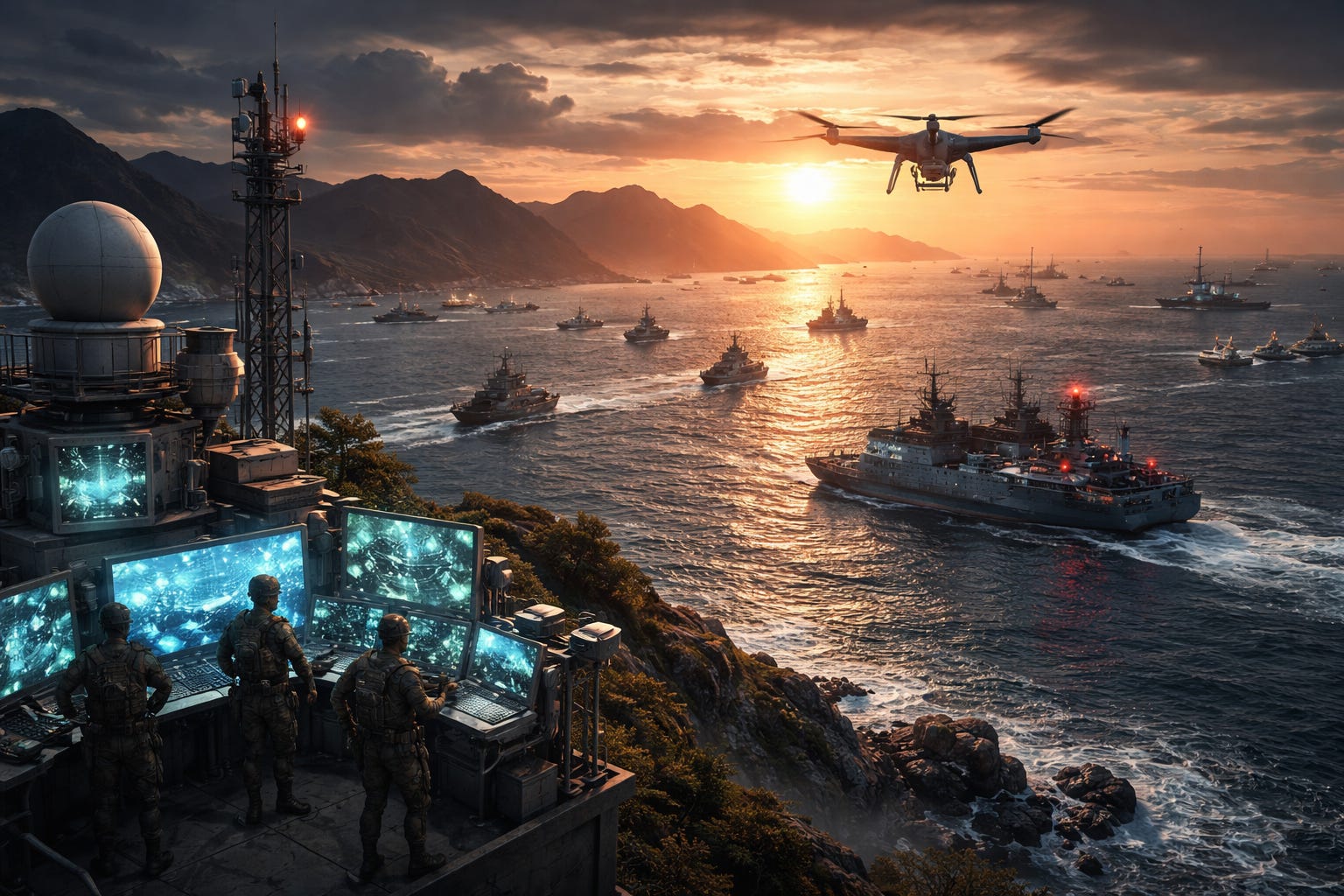
China’s sensor expansion is methodical and accelerating. Huawei infrastructure spans 170 countries. DJI drones dominate commercial surveillance from the Gulf to sub-Saharan Africa. Chinese port management systems across the Red Sea, Mediterranean, and Indian Ocean generate real-time shipping data routed through networks opaque to Western analysts. This is not espionage by another name. It is architecture. And architecture, once installed, is extraordinarily hard to replace.
NATO’s eastern flank tells the same story from a different angle. Post-Cold War members were promised intelligence integration. Most received sanitized summaries while Five Eyes partners accessed real-time feeds. Russia spent years studying those seams. When the crisis came, Ukraine had to build its sensor architecture from commercial satellites, donated systems, and ad hoc arrangements NATO was never designed to accommodate. The intelligence-sharing capability that helped Ukraine survive was built largely outside the systems three decades of alliance investment was supposed to have produced.
Washington’s flagship solution—the Mission Partner Environment—was elegant in concept. In practice, it became one of the most expensive diplomatic failures in alliance management history. The MPE is architecturally hegemonic by design: the US builds the network, sets the rules, controls access, and decides unilaterally what partners see and when. Partners are not architects. They are tenants. And tenants eventually find other landlords. The consequences of that design choice—in Afghanistan, the Gulf, and the Indo-Pacific—are structural: Washington’s answer to the sharing problem replicated the problem in digital form. Fortunately, that seems to be changing with Defense Information System Agency (DISA) Director, LTG Paul Stanton, and the newly appointed Acquisition Executive for the Mission Partner Environment, Nick Creswell, messaging a new direction and investments.
Threading through every historical failure is an export regulatory system built for the Cold War and never seriously reformed. ITAR and EAR licensing was designed to keep American military technology from adversaries. It has, with considerable unintended efficiency, also kept it from allies. Processing times routinely exceed twelve to eighteen months. Gulf officials say it plainly in private: Washington is their preferred partner because they realize that American military technology is still head and shoulders above the rest. Just look at the most recent surgical take-down of one of the region’s most feared military—much of Iran’s naval, air, ground, and nuclear assets were destroyed in mere days. But that very superiority sharpens the sharing paradox: the more advanced the technology becomes, the more restrictive the export regime that governs it, and the less accessible and unreliable Washington becomes as a partner. When procurement runs on eighteen-month political cycles and the American licensing process runs on a twenty-four-month administrative one, the arithmetic speaks for itself.
GCC states are executing the largest military modernization programs in their histories—right now—locking in technical architectures and vendor relationships for a decade or more. Taiwan’s indigenous defense industry is producing increasingly capable sensor and C2 systems under genuine urgency. South Korea and Japan are expanding ISR footprints that create integration opportunities or fragmentation risks, depending entirely on whether Washington acts. America’s competitors understand what Washington has been slow to internalize: in this competition, speed is strategy. The nation that equips a partner’s sensor networks today shapes their threat picture for a generation. The clock is running. But the relationships, the technology, and the institutional frameworks—NATO, the Abraham Accords, the GCC and Indo-Pacific bilateral architectures—all exist. What does not yet exist is the American decision to lead through them. That decision cannot wait.